Sep 23, 2026Pet Product Manufacturing
Aluminum Alloy vs Zinc Alloy Pet Hardware: What Should Dog Brands Choose?
Compare 6061, 7075 aluminum and zinc alloy hardware for dog harnesses and leashes, including weight, strength, finish, cost and OEM applications.
Aluminum Alloy vs Zinc Alloy Pet Hardware: What Should Dog Brands Choose?
When developing a premium dog harness, collar or leash, brands often spend a great deal of time selecting fabric, webbing and colors.
Then hardware is treated as a small detail.
It should not be.
A leash clip can influence product weight, appearance, cost, durability and customer perception. For heavy-duty or outdoor collections, it can also become one of the most important functional components in the entire product.
This is why we increasingly receive questions such as:
Should we use zinc alloy or aluminum alloy?
Is 6061 aluminum strong enough?
Do we need 7075 aerospace-grade aluminum?
If 7075 is stronger as a raw material, will the finished dog clip automatically have a higher breaking load?
The last question is particularly important.
The answer is no—not automatically.
For pet brands, retailers and Amazon sellers developing OEM walking products, hardware should be selected according to the complete component design and intended application, rather than choosing a material based on one impressive specification.
What Hardware Is Commonly Used in Dog Products?
Metal hardware appears throughout a walking collection.
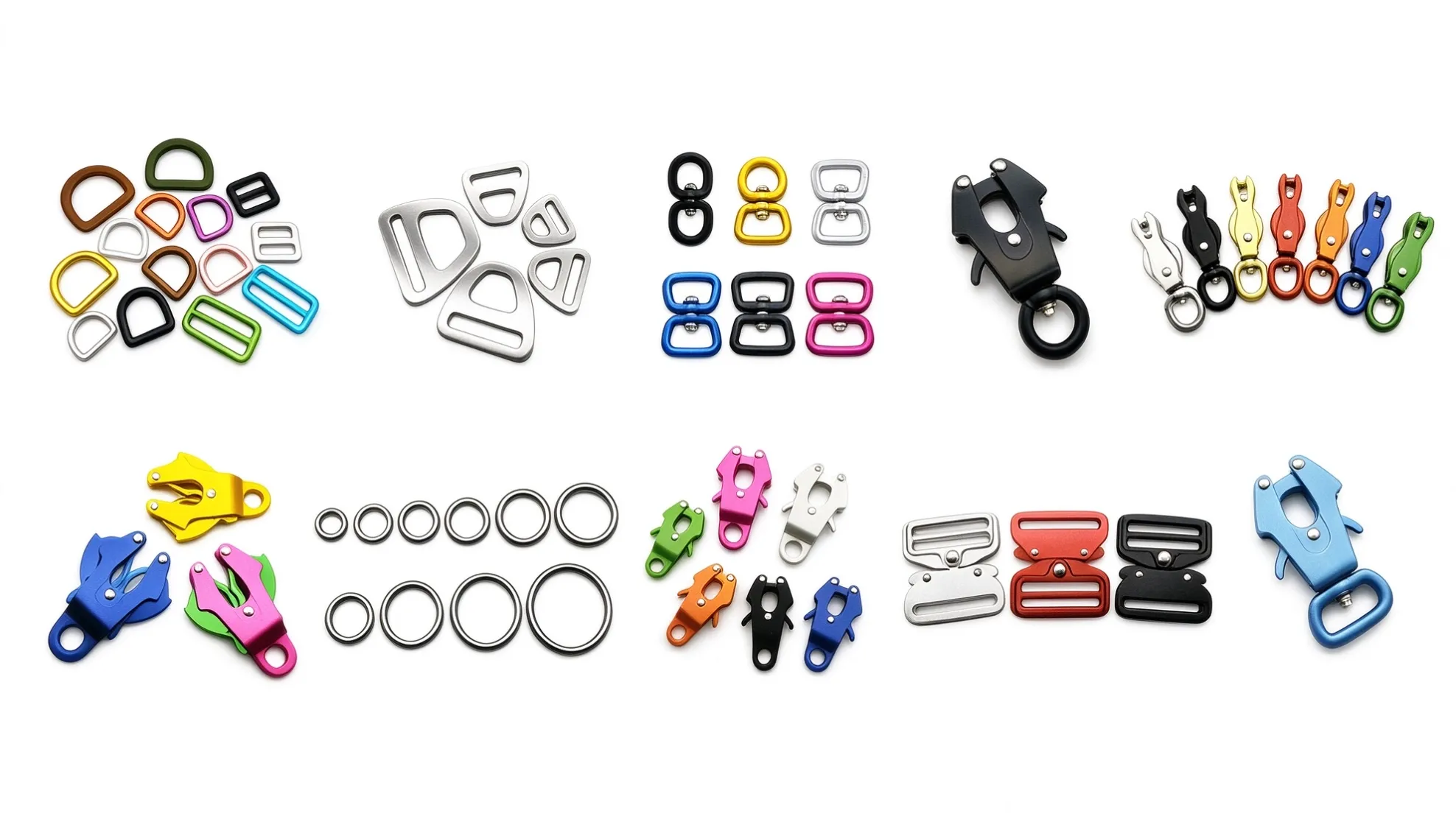
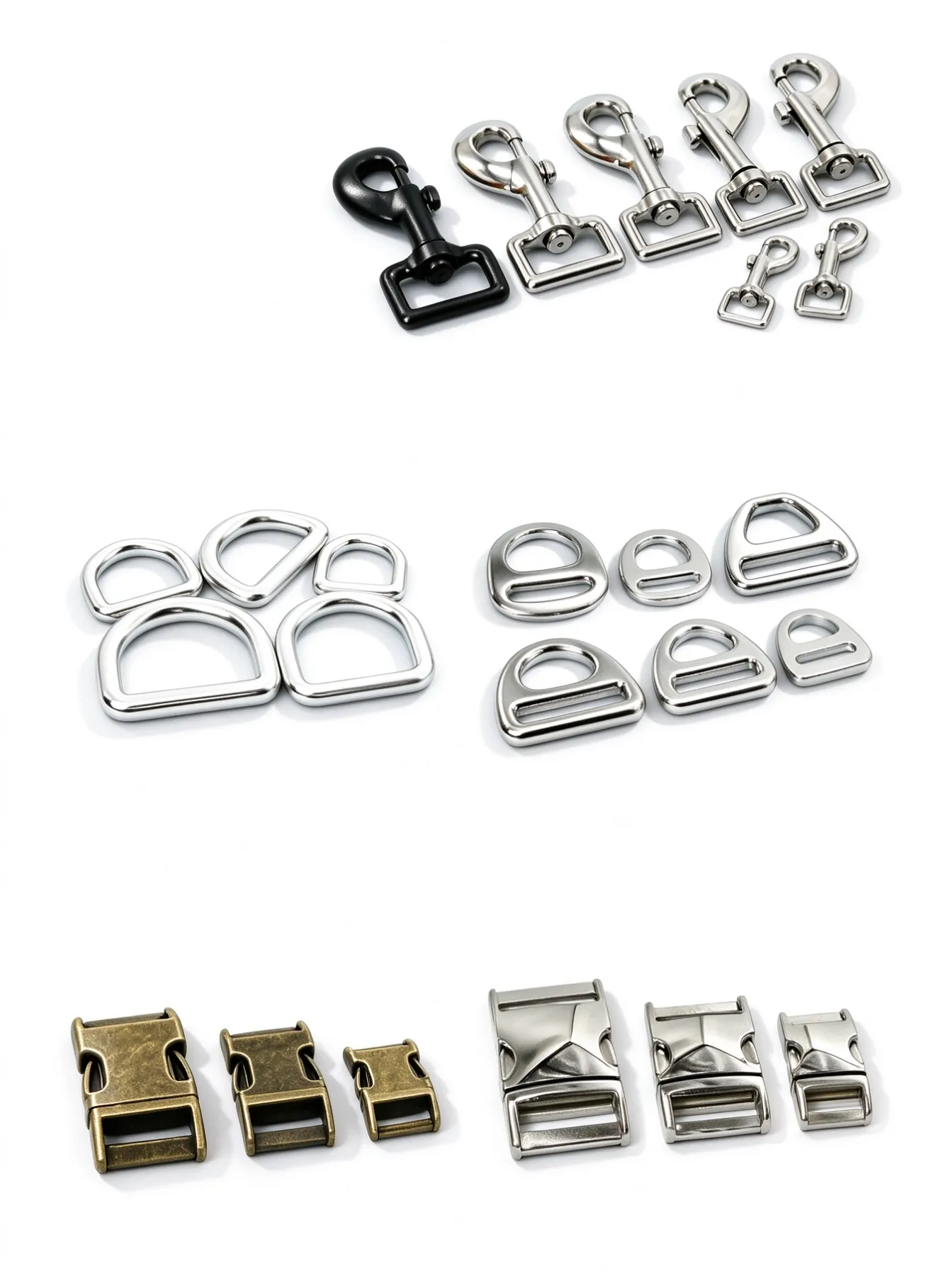
Typical components include:
- Leash snap hooks and carabiners
- D-rings
- O-rings
- Adjusters and sliders
- Metal buckles
- Swivel clips
- Locking clips
- Logo plates
Different components perform different jobs.
A decorative adjuster on a fashion collar does not necessarily need the same material as a locking carabiner on a heavy-duty leash.
That is why asking for “the strongest metal” is usually not the best starting point.
The better question is:
What does this component need to do?
What Is Zinc Alloy Hardware?
Zinc alloy is extremely common in pet accessories.
It is widely used for leash hooks, D-rings, sliders, buckles and decorative components because die casting can produce relatively complex shapes efficiently.
For OEM pet brands, zinc alloy offers several practical advantages.
It can provide a substantial, premium hand feel and supports many decorative finishes, including polished, matte, black, gold-tone and other plated appearances.
It is also generally cost-effective for mainstream commercial pet products.
Its main disadvantage is weight.
A substantial zinc-alloy leash hook can feel noticeably heavier than an aluminum component of comparable overall dimensions.
That may not matter on a standard medium-dog leash.
On a lightweight leash for small dogs, it can matter a lot.
Why Are More Brands Asking About Aluminum Alloy?
Aluminum hardware has become increasingly attractive for outdoor, technical and premium dog products.
The most obvious advantage is:
High strength-to-weight potential.
A well-designed aluminum carabiner can provide useful mechanical performance without the heavy feel of a comparable zinc-alloy component.
This makes aluminum particularly interesting for:
Technical leashes.
Running leashes.
Hands-free leashes.
Outdoor harnesses.
Large-dog walking equipment.
Premium lightweight collections.
It can also create a more engineered appearance, especially when combined with CNC machining, anodized finishes or locking mechanisms.
But “aluminum” is not one single specification.
Different aluminum alloys have different properties.
What Is 6061 Aluminum?
6061 is one of the most widely used aluminum alloys for structural and machined applications.
It offers a useful balance of:
Strength.
Corrosion resistance.
Machinability.
Surface finishing.
Cost.
For many commercial dog leash carabiners and aluminum hardware components, this balance makes 6061 a practical material choice.
This is important for buyers because some product briefs immediately specify 7075 simply because it is perceived as more premium.
But a higher raw-material strength does not automatically mean that 6061 is unsuitable.
For many pet hardware applications, a properly engineered 6061 component may already provide the required performance.
What Is 7075 Aluminum?
7075 is a higher-strength aluminum alloy commonly associated with aerospace and other demanding engineering applications.
Compared with 6061, 7075 generally offers significantly higher mechanical strength at the material level.
This makes the phrase “7075 aerospace-grade aluminum” attractive in product marketing.
However, OEM buyers need to separate two questions:
Question 1: Is 7075 stronger than 6061 as a material?
Generally, yes, depending on temper and specification.
Question 2: Will a 7075 dog leash clip automatically have a higher breaking load than a 6061 clip?
No.
That depends on the finished component.
This distinction is critical.
Why Doesn't 7075 Automatically Mean a Stronger Dog Clip?
Imagine two leash carabiners.
Carabiner A uses 7075 aluminum.
Carabiner B uses 6061 aluminum.
But Carabiner B has:
A thicker load-bearing section.
A stronger gate structure.
A better-designed pivot.
A more suitable locking mechanism.
Better manufacturing consistency.
It is entirely possible for the finished performance gap to be much smaller than a buyer expects—or for component geometry to dominate the result.
The breaking load of a dog clip can depend on:
Material + Temper + Geometry + Cross-Section + Gate Design + Pivot + Manufacturing + Assembly
Therefore, material grade alone should never be used as proof of finished-product strength.
If breaking load matters, ask for finished-component test data.
6061 vs 7075: Which Should a Pet Brand Choose?
For many pet-product projects, the decision can be simplified.
Consider 6061 When:
You want lightweight premium hardware.
The existing component already meets the required performance.
Cost matters.
You need practical commercial quantities.
You want a balance between performance and price.
Consider 7075 When:
The product has a genuinely demanding mechanical requirement.
Weight reduction is especially important.
The component has been engineered around 7075.
The brand positioning specifically justifies the additional material cost.
Relevant testing confirms a meaningful finished-product advantage.
In other words:
Do not upgrade from 6061 to 7075 only because the number is higher.
Upgrade when the finished product benefits.
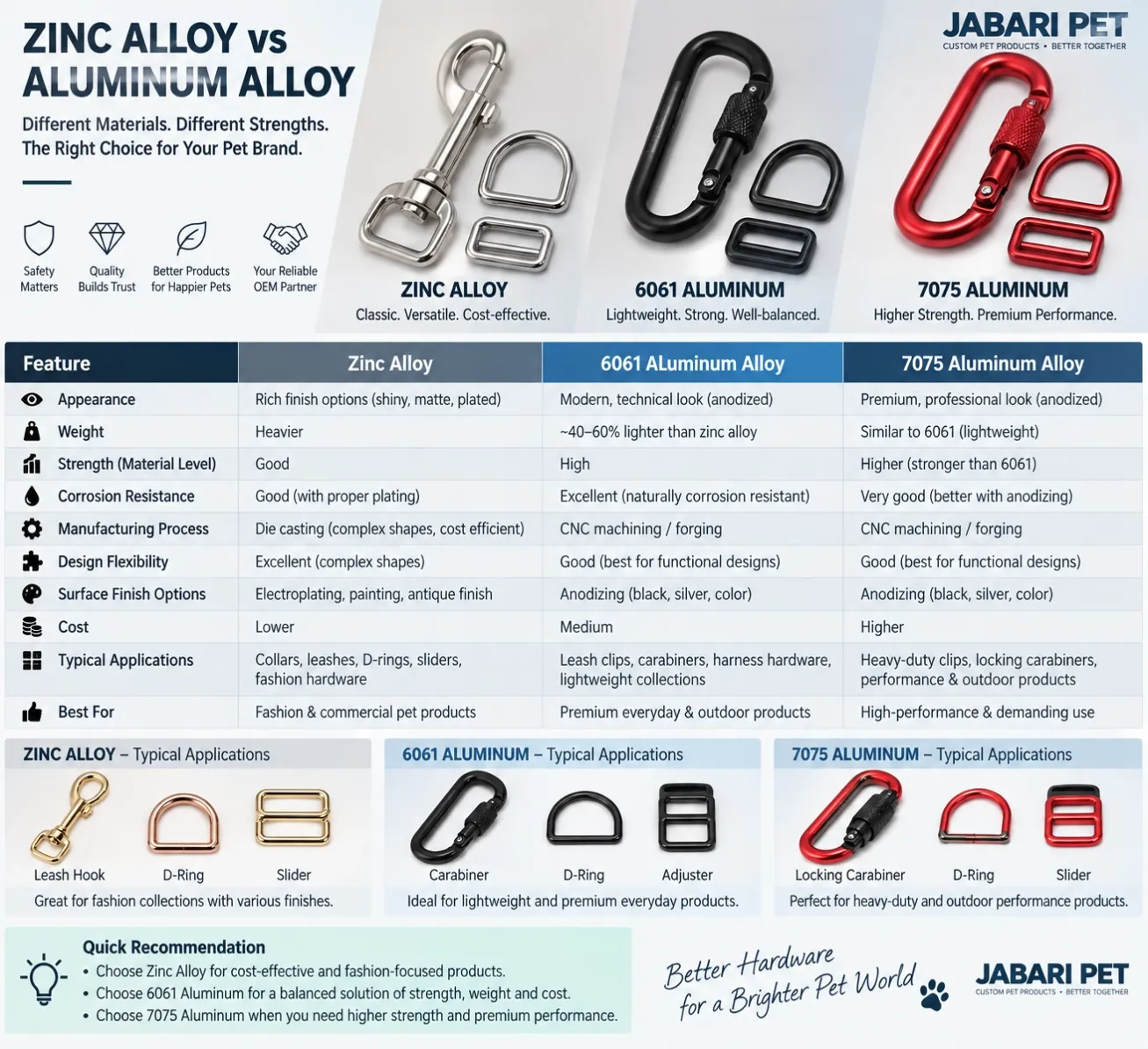
Aluminum Alloy vs Zinc Alloy: What Is the Real Difference?
Factor | Aluminum Alloy | Zinc Alloy |
|---|---|---|
Weight | Lighter | Heavier |
Strength-to-weight | Excellent potential | Good depending on design |
Complex casting shapes | More limited depending on process | Excellent |
Premium technical appearance | Excellent | Excellent for fashion/luxury finishes |
Surface options | Anodizing, coating, machining | Plating, coating, polishing |
Cost | Usually higher | Usually more economical |
Outdoor/technical positioning | Very suitable | Suitable depending on design |
Fashion hardware | Suitable | Very common |
Finished strength | Must be tested | Must be tested |
The important point is that neither material is universally “better.”
They solve different product-development problems.
What About Surface Finish?
Material selection is only part of the hardware specification.
Brands also need to consider the finish.
For aluminum hardware, anodizing can provide attractive colors and improved surface characteristics.
Common directions include:
Black.
Silver.
Gunmetal.
Custom colors depending on MOQ and process.
Zinc alloy provides strong decorative flexibility through plating and coating.
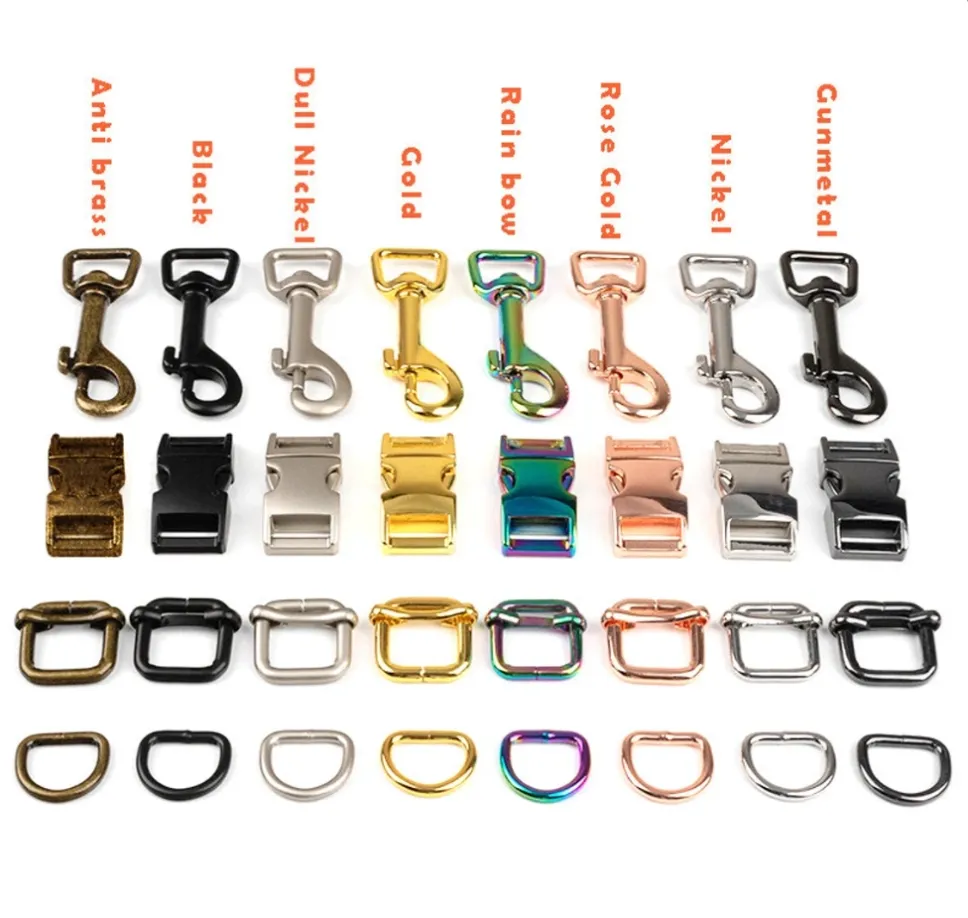
This makes it popular for:
Gold-tone hardware.
Rose gold.
Polished silver.
Gunmetal.
Fashion-focused finishes.
However, brands should remember that finish durability matters.
A beautiful black hook that scratches heavily after several walks may create more complaints than a simpler finish.
For premium collections, surface testing can therefore be as relevant as color selection.
Why Does Hardware Weight Matter?
Hardware weight is often overlooked during online product development.
Consider a leash designed for a 3 kg dog.
A large heavy snap hook may technically be very strong.
But the dog carries that weight near its neck or harness throughout the walk.
That can create a poor product experience.
For small-dog products, lighter hardware may therefore be a meaningful feature.
For large-dog equipment, buyers may prioritize:
Grip.
Locking security.
Component dimensions.
Breaking performance.
The specification should follow the actual user.
Should Heavy-Duty Dog Leashes Always Use Aluminum?
Not necessarily.
A heavy-duty product should be engineered as a complete system.
The leash may contain:
Webbing.
Stitching.
Carabiner.
D-rings.
Adjustment hardware.
Elastic components.
Every load-bearing component matters.
Installing an expensive 7075 carabiner does not make the entire leash “7075 strength.”
If the webbing or stitching fails first, the carabiner's theoretical material strength becomes irrelevant.
For serious heavy-duty development, brands should evaluate the finished leash assembly, not only the hook.
What Should Brands Ask a Hardware Supplier?
When sourcing a premium leash carabiner, do not ask only:
“Is this 7075?”
A stronger RFQ should request:
- Exact aluminum alloy
- Temper, if available
- Overall dimensions
- Attachment-loop dimensions
- Unit weight
- Breaking-load rating
- Available pull-test or manufacturer test data
- Finish/coating specification
- Locking mechanism
- Swivel construction if applicable
- MOQ
- Unit price
- Logo application options
This creates a much more useful comparison between suppliers.
What About Logo Customization?
Hardware can become an important branding surface.
Depending on the component, logos may be applied through:
Laser engraving.
CNC engraving.
Casting.
Embossing.
Custom mold development.
For lower quantities, laser engraving is often one of the more practical approaches because it can avoid a completely new hardware mold.
For larger volumes, custom hardware can create stronger brand recognition.
But custom molds should be justified by expected reorder volume.
A new pet brand usually does not need to custom-mold every metal component in its first collection.
Which Hardware Makes Sense for Different Pet Brand Positions?
A boutique fashion collection might use:
Zinc Alloy + Premium Plating
because appearance and decorative finish are important.
An outdoor collection might use:
6061 Aluminum + Matte/Anodized Finish
to create a lighter, technical feel.
A highly engineered performance leash might evaluate:
7075 Aluminum
if testing and component design demonstrate a meaningful advantage.
A value-focused private-label collection might use:
Proven Zinc-Alloy Hardware
and invest more budget into fit, webbing or packaging.
The material should support the brand proposition.
It should not become the proposition by itself.
How Should Amazon Sellers Compare Hardware?
Amazon sellers should study customer reviews carefully.
Look for complaints such as:
“Hook is too heavy.”
“Clip opened during use.”
“Black finish scratched quickly.”
“Swivel stopped rotating.”
“Hook is too small for the harness ring.”
These are product-development clues.
A competitor using zinc alloy does not automatically mean your product needs aluminum.
First identify the actual customer problem.
Then choose the hardware specification that solves it.
That creates useful differentiation rather than specification inflation.
How JABARI PET Approaches Custom Pet Hardware
At JABARI PET, we work with pet brands, retailers and Amazon sellers developing harnesses, collars, leashes and related walking accessories.
Hardware selection can be discussed according to:
- Intended dog size
- Product positioning
- Weight requirement
- Hardware dimensions
- Material
- Finish
- Locking structure
- Logo method
- MOQ
- Target cost
For many projects, existing proven hardware is the most efficient starting point.
For higher-volume or more technical projects, customized aluminum hardware, engraving or specific performance requirements can be evaluated.
Where strength is commercially important, we recommend evaluating actual component or finished-product test data rather than relying only on the material name.
Final Answer: Don't Buy the Alloy Number—Buy the Right Performance
7075 sounds more advanced than 6061.
Aluminum sounds more technical than zinc alloy.
But good OEM development is not about selecting the material with the strongest marketing language.
It is about selecting the component that fits the product.
For a dog leash, consider:
Weight.
Geometry.
Breaking performance.
Locking mechanism.
Surface durability.
Cost.
MOQ.
Brand positioning.
A well-designed 6061 aluminum carabiner may be a better commercial choice than an unnecessarily expensive 7075 component.
A proven zinc-alloy hook may be exactly right for a fashion leash.
And when genuine high-performance hardware is required, 7075 can be worth evaluating—but the finished component still needs to prove its performance.
For pet brands sourcing custom harnesses, collars and leashes, the best question is therefore not:
“Which alloy sounds strongest?”
It is:
“Which finished hardware gives this product the right combination of safety, weight, durability, appearance and cost?”
That is the specification that matters.